
Lakeland Hills
Lakeland Hills was developed and built by Longhorn Construction, a subsidiary of Ben Sira Construction. Longhorn Construction consisted of Alfred A Holmberg, Huber Boedeker, Waller C Boedeker, Clyde S Constant, and Bill H Bishop, all important figures in the Dallas building scene during this period. This historic Mid-Century section of Highland Meadows includes parts of Rolling Rock Lane, Glen Echo Court, Cactus Lane, Lubbock Drive, Quail Run, Hackney Lane, Shagrock Lane, and Capri Drive.
Homes in Lakeland Hills were a showcase of custom contemporary design in the 1950’s with homes designed by a list of noted architects including Harry E Marlow, Richard A Ferrara Sr, Arch B Swank Jr, E Dow Davidson Sr, and J Stuart Todd. Lakeland Hills was originally planned as a development of 1400 homes on a 300 acre tract bordered by Northwest Highway on the South, Jupiter Rd on the East, and Kingsley Rd (now Walnut Hill Ln) on the North. It would have been the world’s largest all air-conditioned development. The projected cost of Lakeland Hills in 1955 was an astonishing $20,000,000 or $217,000,000 in 2025.
Longhorn Construction began building in the summer of 1955 and ended construction in 1959 after the death of Huber Boedeker on December 15, 1958. Although Longhorn Construction didn’t complete the planned 1400 homes in Lakeland Hills, the 100 homes that were constructed are an important collection of architecturally significant homes that stand as a reminder of the optimism and aspirations of post-war America.
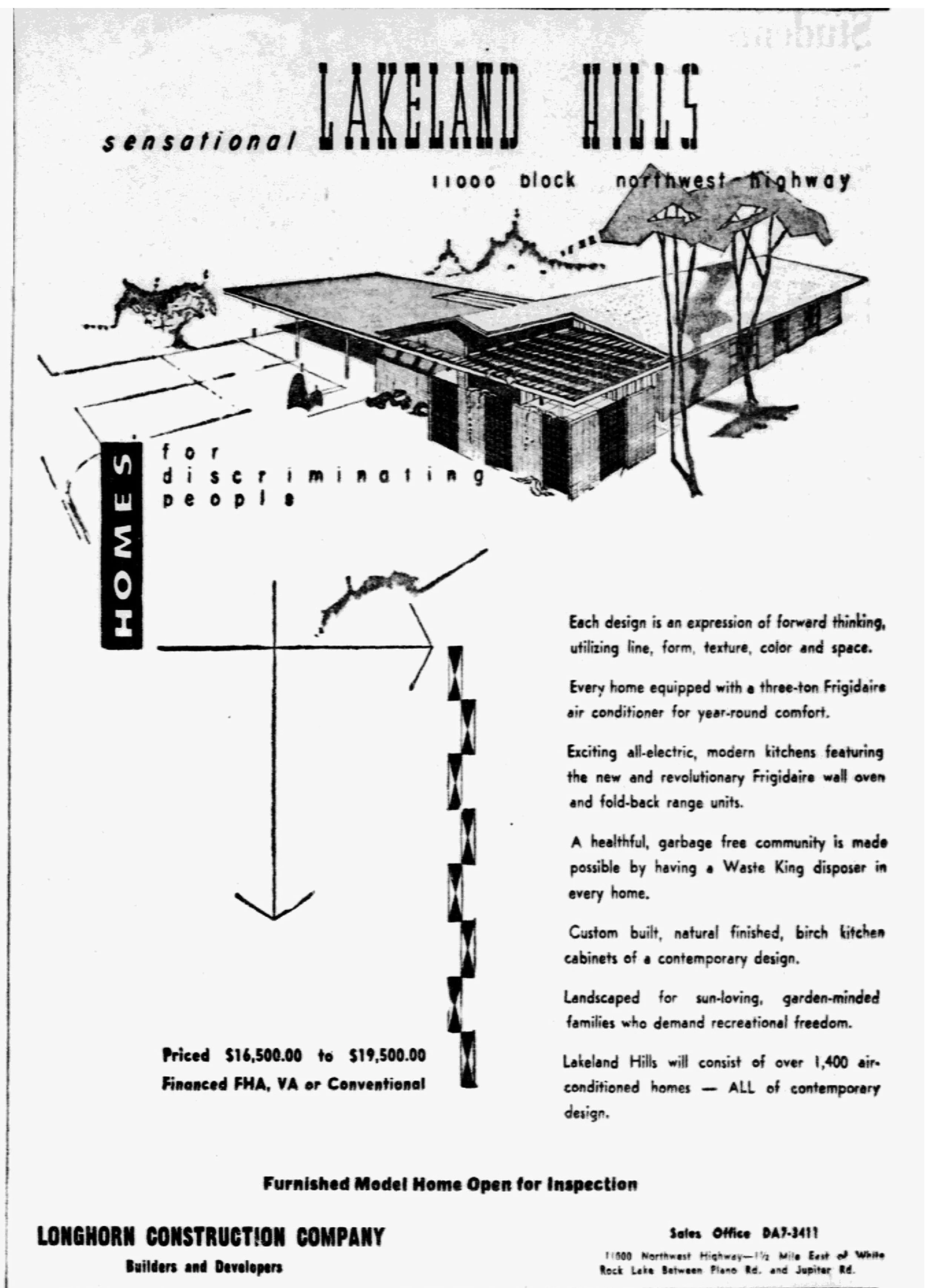
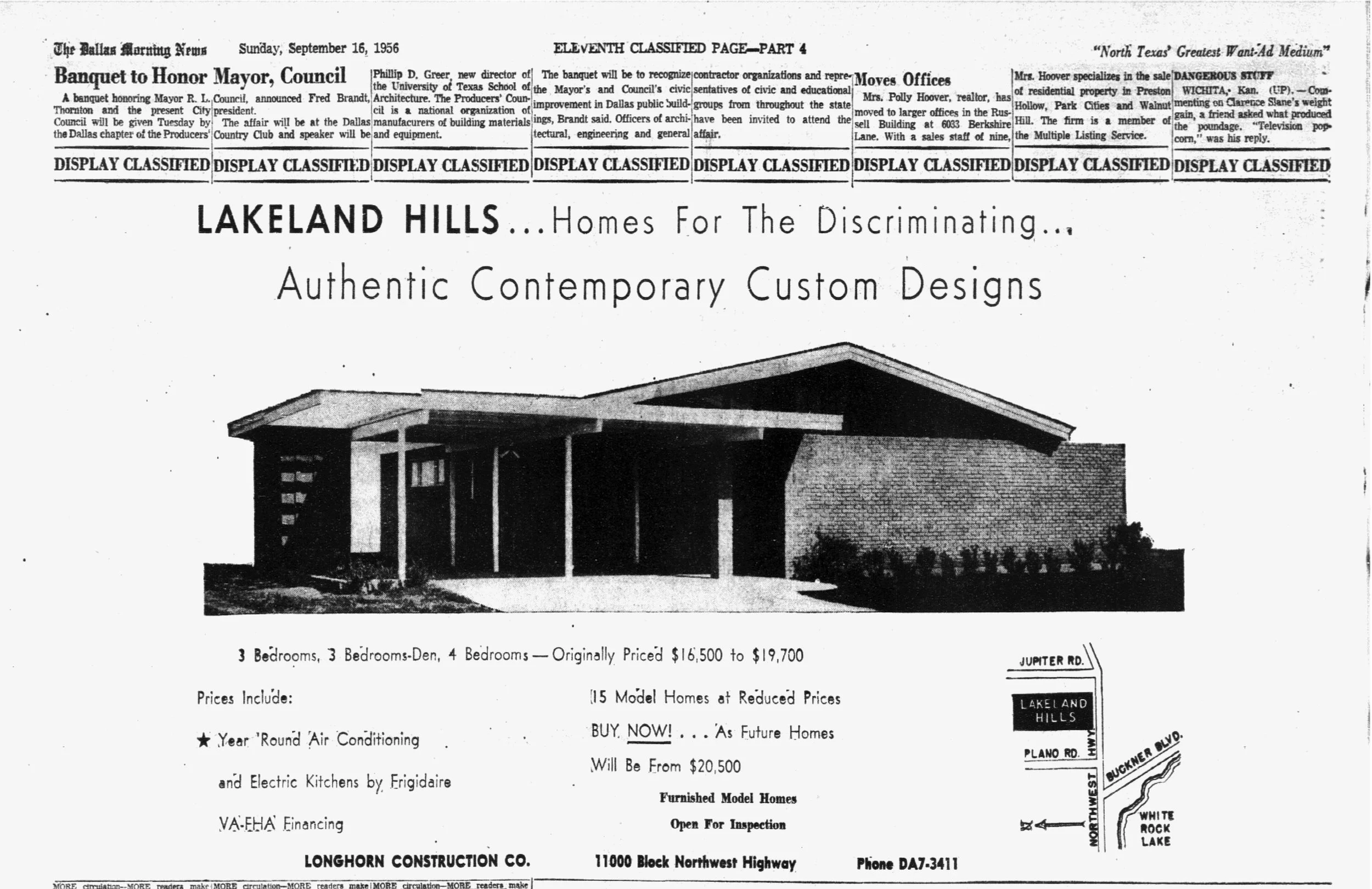
Lakeland Hills - Authentic Contemporary Custom Designs
September 16, 1956 - Dallas Morning News
This advertisement features a home designed by Harry E Marlow at 8506 Rolling Rock. Homes in Lakeland Hills were offered in three bedroom, three bedroom + den, and four bedroom. All homes featured “year round air conditioning”, and an all electric kitchen by Frigidaire.
Originally priced between $16,500 to $19,700…
Longhorn Construction Co.
Original Ad for Lakeland Hills, September 16, 1956 - Highland Meadows Preservation Foundation
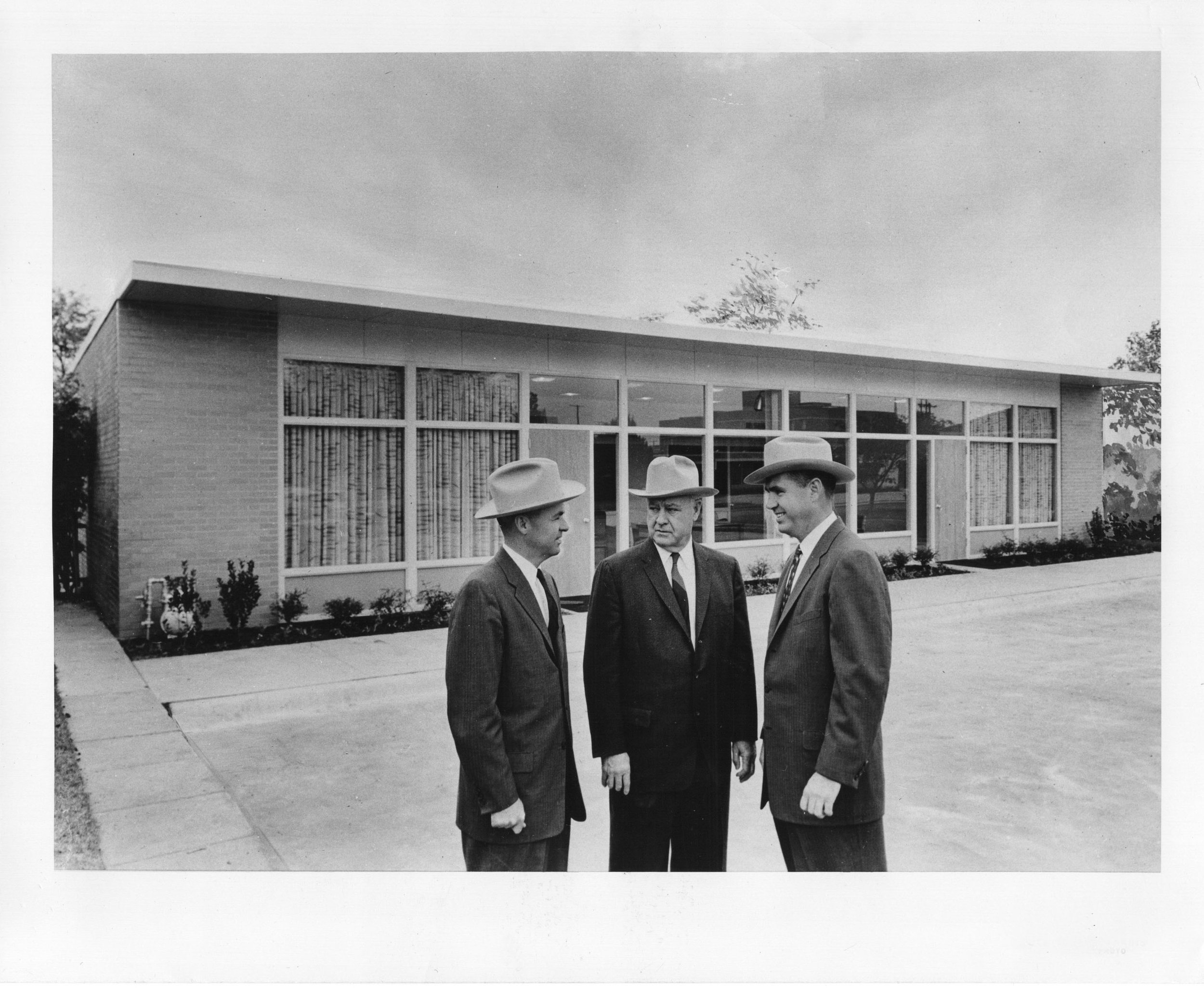
Longhorn Construction - Lakeland Hills
Alfred A. Holmberg - President
Waller C. Boedecker - Vice President
Clyde S. Constant - Vice President
B. H. Bishop - Secretary-Treasurer
Huber Boedecker - Partner
Harry E. Marlow - Project Coordinator
photo: 1957, by Squire Haskins - Highland Meadows Preservation Archive
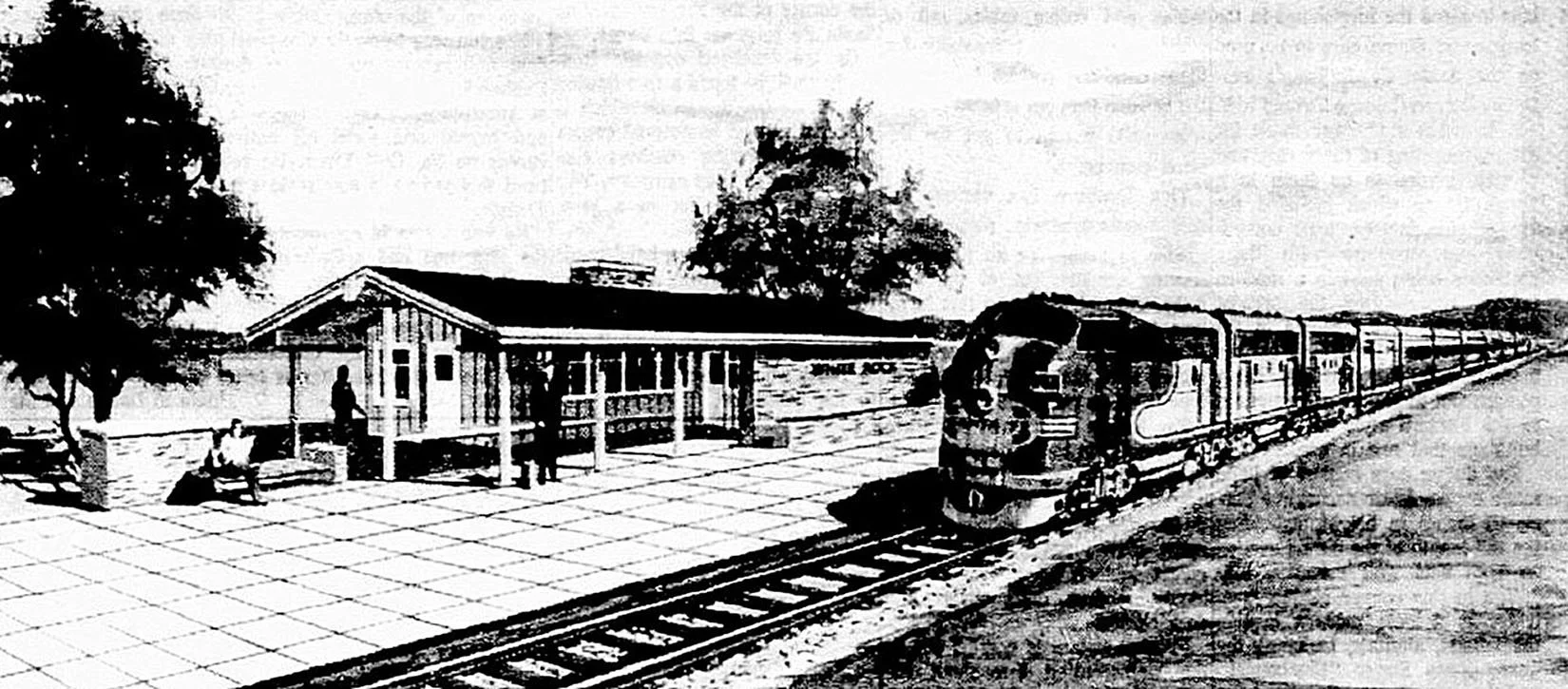
Lakeland Hills, White Rock Commuter Rail Station
Strategically located, Lakeland Hills early advertisements boasted its close proximity to the newly opened Santa Fe Railroad’s White Rock Station.
The White Rock passenger station opened on December 5, 1955 on Jupiter Rd, about a quarter mile south of Kingsley, a few miles northeast of White Rock Lake.
The swanky streamlined Texas Chief shuttled passengers between Dallas’ Union Station and Chicago in about 19 hours - travel time between Union Station and the new White Rock Station was 25 - 30 minutes.
The Santa Fe Railroad’s White Rock Station was demolished in 1968.
Illustration of the Santa Fe Railroad’s White Rock Station, 1955, courtesy of Portal to Texas History - Highland Meadows Preservation Foundation
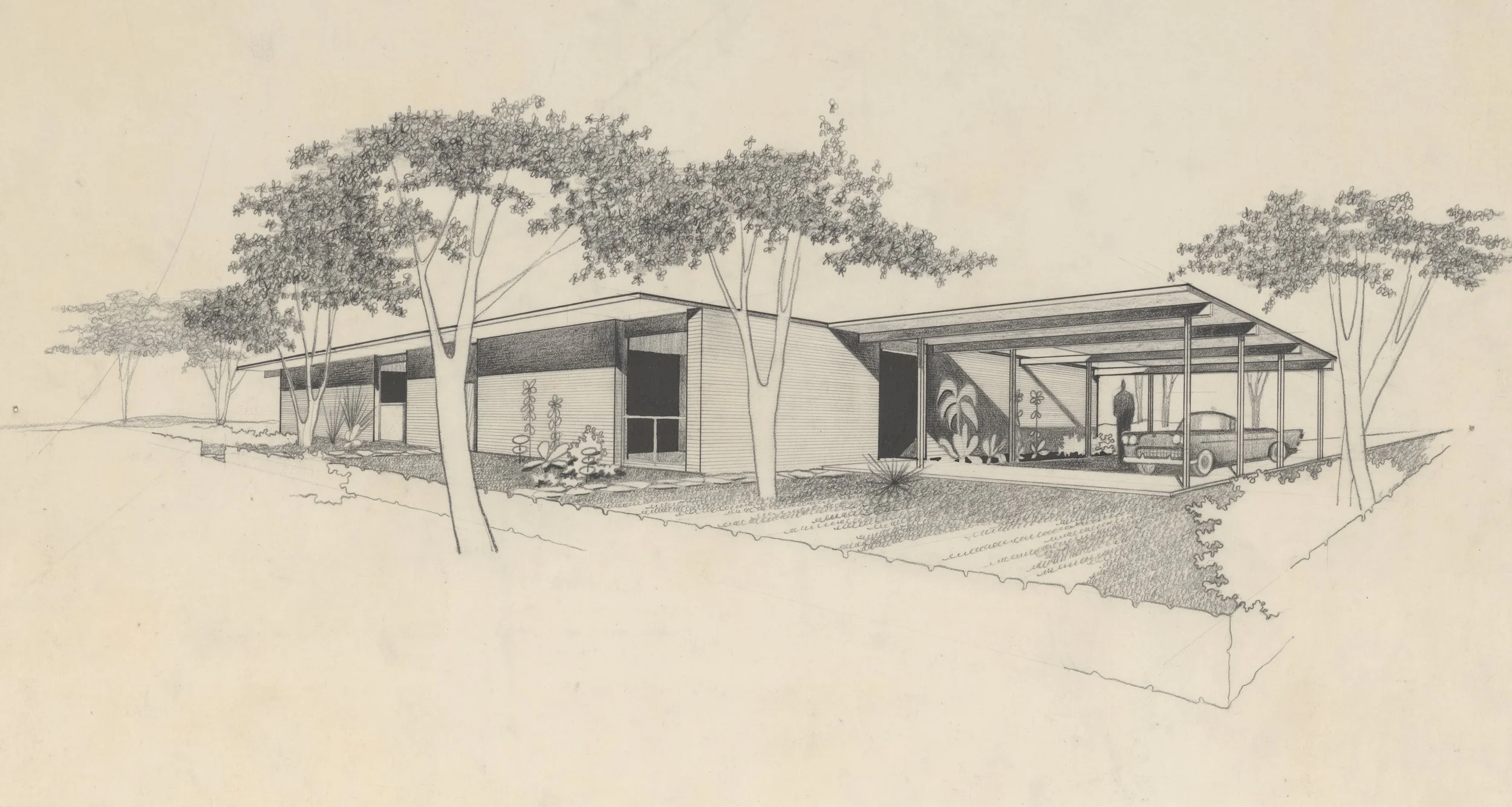
Illustration for the Hughes Home
Illustration of the “Hughes Home, architect Arch B. Swank, 1957, Lakeland Hills”
Milton Hughes and Anne Hughes commissioned Arch B Swank and Associates to design their home on Cactus Ln in 1957. Milton was born in 1922 in Lake Forest, Illinois and served in the military in World War II. He attended Southern Methodist University and graduated with degrees in geology and psychology. Milton began working as a geologist for Atlantic Refining, later Atlantic Ritchfield Corporation soon after graduation.
Illustration of the Hughes Home, 1957, by J Stuart Todd, courtesy of Alexander Architectural Archive - Highland Meadows Preservation Foundation
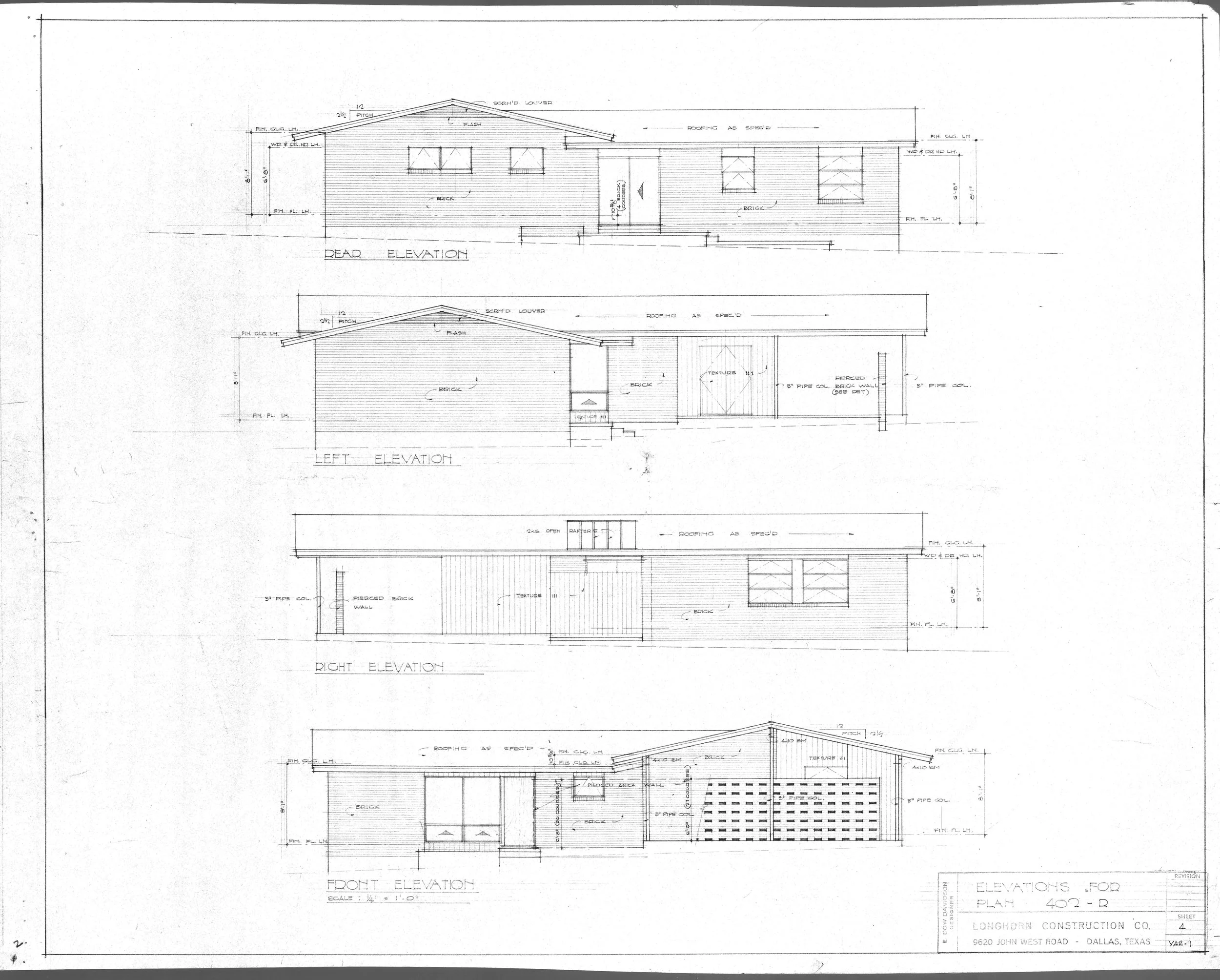
Norris Home Elevations, E. Dow Davidson Sr. Architect, Longhorn Construction
Elevation of "the “Norris Home, architect E. Dow Davidson Sr., 1956, Lakeland Hills.”
Built for Lieutenant Colonel Pelham Norris by Longhorn Construction and designed by E. Dow Davidson Sr. in 1956, this home was on of the first homes completed on Glen Echo Ct in Lakeland Hills.
Pelham Norris was born in Rock City, Tennessee in 1922. He was a graduate of Vanderbilt University with a B.S. in Civil Engineering . He served as a B-17 pilot in World War II and stayed in the Air Force for 29 years before retiring. He served in World War II, Vietnam. and the Cuban Missile Crisis where he was chosen to transport a special German made camera from New York to Florida for the photographing of the missiles. He was qualified to fly not only the B-17 but also the F-86 fighter jet, and the C-119 troop carrier.
After retiring from the Air Force, Pelham Norris began a new career as an actor and model. He was signed with the Kim Dawson Agency where he worked with hundreds of clients, made numerous television commercials, and appeared in a recurring role on the TV series Dallas.
At this time these are the only plans known to exist of any of the homes built by Longhorn Construction in the Lakeland Hills section of Highland Meadows.
Elevations courtesy of Stacy Welch - Highland Meadows Preservation Foundation
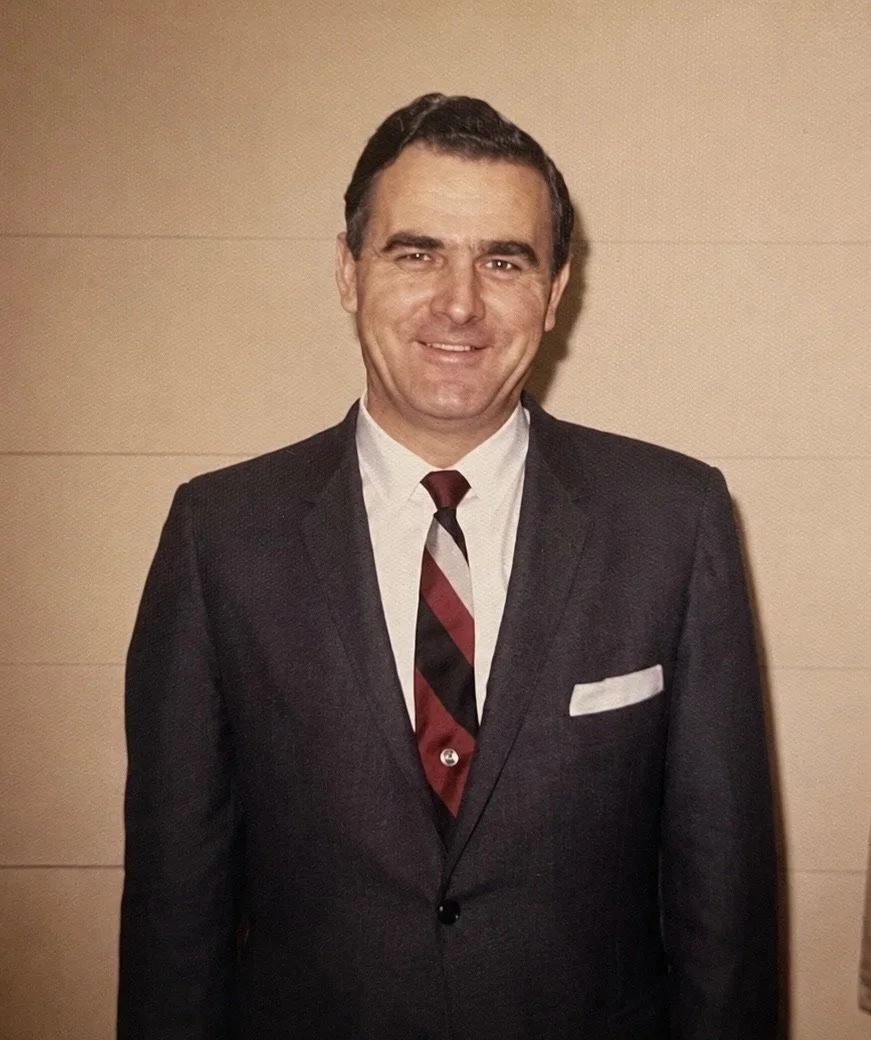
Harry E Marlow - Lakeland Hills, Project Coordinator
When Longhorn Construction began planning the Lakeland Hills they knew they would need an individual with expertise in various areas to manage all of the different facets of development. With experience in permitting, construction, design, real estate, sales and business, Harry E Marlow was uniquely qualified to bring Lakeland Hills from an idea to a showcase of modern design.
In addition to managing all of the various aspects of Lakeland Hills as it took shape, he also designed a few of the homes in the development.
Photograph of Harry E. Marlow, 1960, courtesy of Modell Marlow Andersen and Deborah Marlow Mejia - Highland Meadows Preservation Foundation
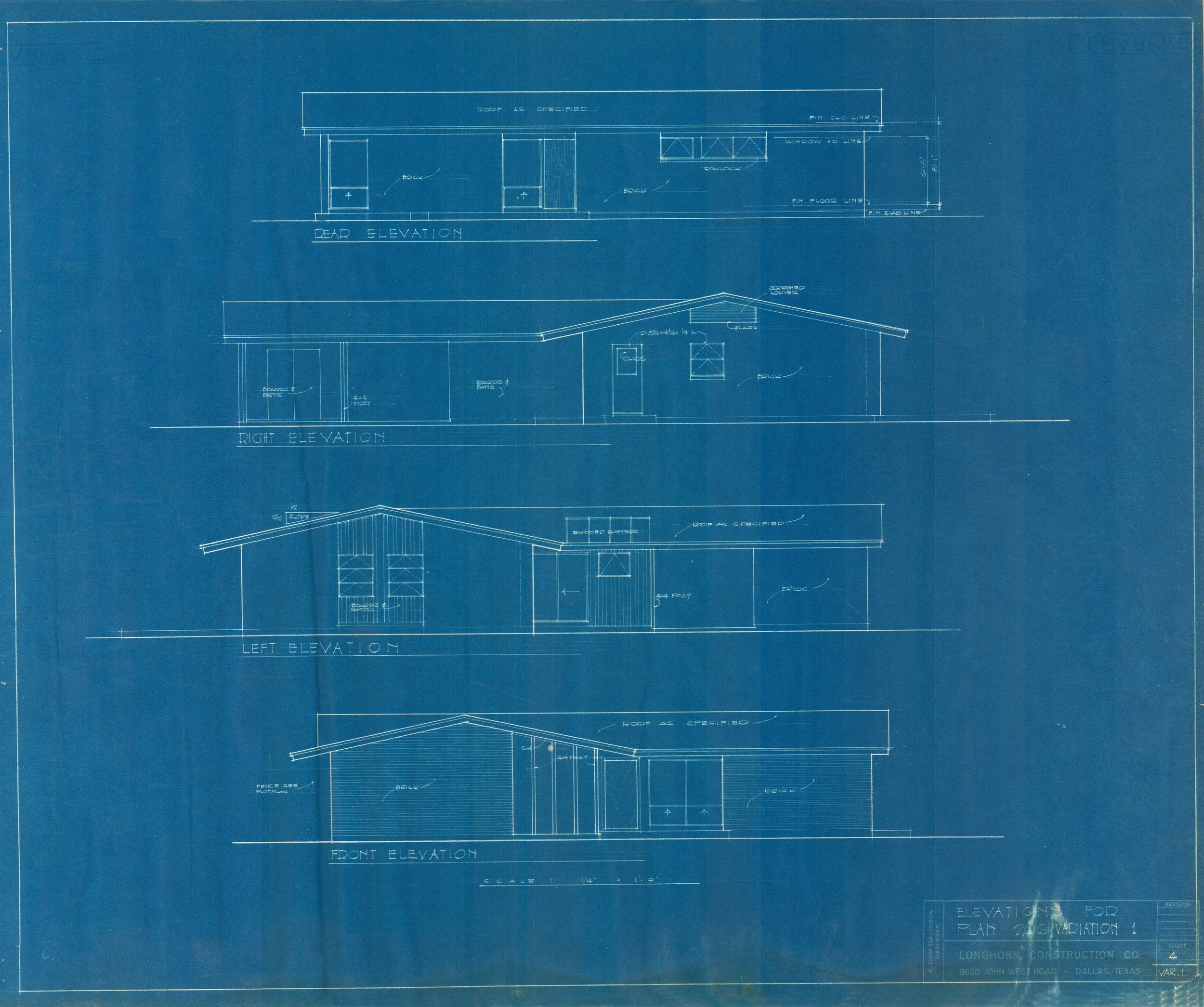
Cable Home Elevations, E. Dow Davidson Sr. Architect, Longhorn Construction
Elevations of the “Cable Home, Architect E. Dow Davidson Sr., 1956, Lakeland Hills.”
Built for Edwin Davis Cable (Ned) and his wife Hazel Ruth Mckinney Cable, this design was replicated at seven Lakeland Hills homes. The design was rotated at each home and the design elements changed to assure that each home was unique and individual.
Edwin Davis Cable was born in Tulsa, Oklahoma in 1925 and his parents soon after relocated to Wichita Falls, Texas. Ned enlisted in the Navy in 1943 and served as an ensign. After the war he graduated from the University of Texas at Austin with a degree in Petroleum Engineering. He worked for 22 years at the Republic National Bank as an Evaluation Engineer and Bank Officer. He later started his own firm.
Ned moved to Dallas in 1949 where he met his wife Hazel Ruth Mckinney and in 1956 the couple purchased a home on Quail Run in Lakeland Hills.
Elevations courtesy of Larry Beamer - Highland Meadows Preservation Foundation